There is a place with four suns in the sky — red, white, blue, and yellow; two of them are so close together that they touch, and star-stuff flows between them. I know of a world with a million moons. I know of a sun the size of the Earth — and made of diamond. There are atomic nuclei a few miles across which rotate thirty times a second. There are tiny grains between the stars, with the size and atomic composition of bacteria. There are stars leaving the Milky Way, and immense gas clouds falling into it. There are turbulent plasmas writhing with X- and gamma-rays and mighty stellar explosions. There are, perhaps, places which are outside our universe. The universe is vast and awesome, and for the first time we are becoming a part of it.
The truth may be puzzling. It may take some work to grapple with. It may be counterintuitive. It may contradict deeply held prejudices. It may not be consonant with what we desperately want to be true. But our preferences do not determine what's true. We have a method, and that method helps us to reach not absolute truth, only asymptotic approaches to the truth — never there, just closer and closer, always finding vast new oceans of undiscovered possibilities. Cleverly designed experiments are the key.
I would love to believe that when I die I will live again, that some thinking, feeling, remembering part of me will continue. But much as I want to believe that, and despite the ancient and worldwide cultural traditions that assert an afterlife, I know of nothing to suggest that it is more than wishful thinking. The world is so exquisite with so much love and moral depth, that there is no reason to deceive ourselves with pretty stories for which there's little good evidence. Far better it seems to me, in our vulnerability, is to look death in the eye and to be grateful every day for the brief but magnificent opportunity that life provides.
 Richard Feynman·1955
I stand at the seashore, alone, and start to think. There are the rushing waves mountains of molecules each stupidly minding its own business trillions apart yet forming white surf in unison. Ages on ages before any eyes could see year after year thunderously pounding the shore as now. For whom, for what? On a dead planet with no life to entertain. Never at rest tortured by energy wasted prodigiously by the sun poured into space. A mite makes the sea roar. Deep in the sea all molecules repeat the patterns of one another till complex new ones are formed. They make others like themselves and a new dance starts. Growing in size and complexity living things masses of atoms DNA, protein dancing a pattern ever more intricate. Out of the cradle onto dry land here it is standing: atoms with consciousness; matter with curiosity. Stands at the sea, wonders at wondering: I a universe of atoms an atom in the universe.
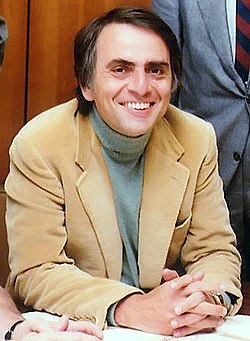 Carl Sagan·1970
There is a place with four suns in the sky — red, white, blue, and yellow; two of them are so close together that they touch, and star-stuff flows between them. I know of a world with a million moons. I know of a sun the size of the Earth — and made of diamond. There are atomic nuclei a few miles across which rotate thirty times a second. There are tiny grains between the stars, with the size and atomic composition of bacteria. There are stars leaving the Milky Way, and immense gas clouds falling into it. There are turbulent plasmas writhing with X- and gamma-rays and mighty stellar explosions. There are, perhaps, places which are outside our universe. The universe is vast and awesome, and for the first time we are becoming a part of it.
 John Muir
When we try to pick out anything by itself, we find it hitched to everything else in the universe.