Western civilization, it seems to me, stands by two great heritages. One is the scientific spirit of adventure — the adventure into the unknown, an unknown which must be recognized as being unknown in order to be explored; the demand that the unanswerable mysteries of the universe remain unanswered; the attitude that all is uncertain; to summarize it — the humility of the intellect. The other great heritage is Christian ethics — the basis of action on love, the brotherhood of all men, the value of the individual — the humility of the spirit. These two heritages are logically, thoroughly consistent. But logic is not all; one needs one's heart to follow an idea. If people are going back to religion, what are they going back to? Is the modern church a place to give comfort to a man who doubts God — more, one who disbelieves in God? Is the modern church a place to give comfort and encouragement to the value of such doubts? So far, have we not drawn strength and comfort to maintain the one or the other of these consistent heritages in a way which attacks the values of the other? Is this unavoidable? How can we draw inspiration to support these two pillars of western civilization so that they may stand together in full vigor, mutually unafraid? Is this not the central problem of our time?
Hell, if I could explain it to the average person, it wouldn't have been worth the Nobel prize.
A very great deal more truth can become known than can be proven.
 Immanuel Kant·1788
Two things fill the mind with ever new and increasing admiration and awe, the more often and steadily we reflect upon them: the starry heavens above me and the moral law within me. I do not merely conjecture them and seek them as though obscured in darkness or in the transcendent region beyond my horizon: I see them before me, and I associate them directly with the consciousness of my own existence.
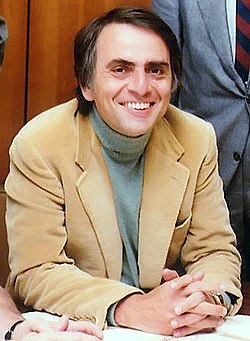 Carl Sagan·1970
There is a place with four suns in the sky — red, white, blue, and yellow; two of them are so close together that they touch, and star-stuff flows between them. I know of a world with a million moons. I know of a sun the size of the Earth — and made of diamond. There are atomic nuclei a few miles across which rotate thirty times a second. There are tiny grains between the stars, with the size and atomic composition of bacteria. There are stars leaving the Milky Way, and immense gas clouds falling into it. There are turbulent plasmas writhing with X- and gamma-rays and mighty stellar explosions. There are, perhaps, places which are outside our universe. The universe is vast and awesome, and for the first time we are becoming a part of it.
 Richard Feynman·1955
I stand at the seashore, alone, and start to think. There are the rushing waves mountains of molecules each stupidly minding its own business trillions apart yet forming white surf in unison. Ages on ages before any eyes could see year after year thunderously pounding the shore as now. For whom, for what? On a dead planet with no life to entertain. Never at rest tortured by energy wasted prodigiously by the sun poured into space. A mite makes the sea roar. Deep in the sea all molecules repeat the patterns of one another till complex new ones are formed. They make others like themselves and a new dance starts. Growing in size and complexity living things masses of atoms DNA, protein dancing a pattern ever more intricate. Out of the cradle onto dry land here it is standing: atoms with consciousness; matter with curiosity. Stands at the sea, wonders at wondering: I a universe of atoms an atom in the universe.