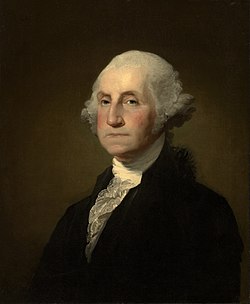
It is substantially true, that virtue or morality is a necessary spring of popular government. The rule, indeed, extends with more or less force to every species of free government.

“The best laws cannot make a constitution work in spite of morals; morals can turn the worst laws to advantage. That is a commonplace truth, but one to which my studies are always bringing me back. It is the central point in my conception. I see it at the end of all my reflections.”
It is substantially true, that virtue or morality is a necessary spring of popular government. The rule, indeed, extends with more or less force to every species of free government.

Statesmen, my dear Sir, may plan and speculate for Liberty, but it is Religion and Morality alone, which can establish the Principles upon which Freedom can securely stand. The only foundation of a free Constitution is pure Virtue, and if this cannot be inspired into our People in a greater Measure than they have it now, They may change their Rulers and the forms of Government, but they will not obtain a lasting Liberty. They will only exchange Tyrants and Tyrannies.

Manners are of more importance than laws. The law can touch us here and there, now and then. Manners are what vex or soothe, corrupt or purify, exalt or debase, barbarize or refine us, by a constant, steady, uniform, insensible operation like that of the air we breathe in.
Let us with caution indulge the supposition, that morality can be maintained without religion. Whatever may be conceded to the influence of refined education on minds of peculiar structure, reason and experience both forbid us to expect, that national morality can prevail in exclusion of religious principle.
Of all the dispositions and habits, which lead to political prosperity, Religion and Morality are indispensable supports. In vain would that man claim the tribute of Patriotism, who should labor to subvert these great pillars of human happiness, these firmest props of the duties of Men and Citizens. The mere Politician, equally with the pious man, ought to respect and to cherish them. A volume could not trace all their connexions with private and public felicity.

Guide the people by law, subdue them by punishment; they may shun crime, but will be void of shame. Guide them by example, subdue them by courtesy; they will learn shame, and come to be good.
The ancients who wished to illustrate illustrious virtue throughout the Kingdom, first ordered well their own states. Wishing to order well their states, they first regulated their families. Wishing to regulate their families, they first cultivated their persons. Wishing to cultivate their persons, they first rectified their hearts. Wishing to rectify their hearts, they first sought to be sincere in their thoughts. Wishing to be sincere in their thoughts, they first extended to the utmost their knowledge. Such extension of knowledge lay in the investigation of things. Things being investigated, knowledge became complete. Their knowledge being complete, their thoughts were sincere. Their thoughts being sincere, their hearts were then rectified. Their hearts being rectified, their persons were cultivated. Their persons being cultivated, their families were regulated. Their families being regulated, their states were rightly governed. Their states being rightly governed, the whole kingdom was made tranquil and happy. From the Son of Heaven down to the mass of the people, all must consider the cultivation of the person the root of everything besides.

We must ever bear in mind that the great end in view is righteousness, justice as between man and man, nation and nation, the chance to lead our lives on a somewhat higher level, with a broader spirit of brotherly goodwill one for another. Peace is generally good in itself, but it is never the highest good unless it comes as the handmaid of righteousness; and it becomes a very evil thing if it serves merely as a mask for cowardice and sloth, or as an instrument to further the ends of despotism or anarchy. We despise and abhor the bully, the brawler, the oppressor, whether in private or public life, but we despise no less the coward and the voluptuary. No man is worth calling a man who will not fight rather than submit to infamy or see those that are dear to him suffer wrong. No nation deserves to exist if it permits itself to lose the stern and virile virtues; and this without regard to whether the loss is due to the growth of a heartless and all-absorbing commercialism, to prolonged indulgence in luxury and soft, effortless ease, or to the deification of a warped and twisted sentimentality.

We must know what we think and speak out, even at the risk of unpopularity. In the final analysis, a democratic government represents the sum total of the courage and the integrity of its individuals. It cannot be better than they are. … In the long run there is no more exhilarating experience than to determine one's position, state it bravely and then act boldly.

The law will never make men free; it is men who have got to make the law free.
Bad laws are the worst sort of tyranny.
The people as a whole can be benefited morally and materially by a system which shall permit of ample reward for exceptional efficiency, but which shall nevertheless secure to the average man, who does his work faithfully and well, the reward to which he is entitled. Remember that I speak only of the man who does his work faithfully and well. The man who shirks his work, who is lazy or vicious, or even merely incompetent, deserves scant consideration; we may be sorry for his family, but it is folly to waste sympathy on the man himself; and it is also folly for sentimentalists to try to shift the burden of blame from such a man himself to “society” and it is an outrage to give him the reward given to his hard-working, upright, and efficient brother. Still less should we waste sympathy on the criminal; there are altogether too many honest men who need it; and one chief point in dealing with the criminal should be to make him understand that he will be in personal peril if he becomes a lawbreaker. I realize entirely that in the last analysis, with the nation as with the individual, it is private character that counts for most. It is because of this realization that I gladly lay myself open to the charge that I preach too much, and dwell too much upon moral commonplaces; for though I believe with all my heart in the nationalization of this Nation—in the collective use on behalf of the American people of the governmental powers which can be derived only from the American people as a whole—yet I believe even more in the practical application by the individual of those great fundamental moralities.
We must see that there is civic honesty, civic cleanliness, civic good sense in our home administration of city, State, and nation. We must strive for honesty in office, for honesty toward the creditors of the nation and of the individual; for the widest freedom of individual initiative where possible, and for the wisest control of individual initiative where it is hostile to the welfare of the many. But because we set our own household in order we are not thereby excused from playing our part in the great affairs of the world. A man's first duty is to his own home, but he is not thereby excused from doing his duty to the State; for if he fails in this second duty it is under the penalty of ceasing to be a freeman. In the same way, while a nation's first duty is within its own borders, it is not thereby absolved from facing its duties in the world as a whole; and if it refuses to do so, it merely forfeits its right to struggle for a place among the peoples that shape the destiny of mankind.

'But,' I [Dmitri Karamazov] asked, 'how will man be after that? Without God and the future life? It means everything is permitted now, one can do anything?' 'Didn't you know?' he said. And he laughed. 'Everything is permitted to the intelligent man,' he said.
If we lose the virile, manly qualities, and sink into a nation of mere hucksters, putting gain over national honor, and subordinating everything to mere ease of life, then we shall indeed reach a condition worse than that of the ancient civilizations in the years of their decay.

All human laws are nourished by one divine law.

Of a surety, at the Day of Judgment it will be demanded of us, not what we have read, but what we have done; not how well we have spoken, but how holily we have lived.

Men never do good unless necessity drives them to it; but when they are free to choose and can do just as they please, confusion and disorder become rampant.
Wealth and honor are what every man desires. But if they have been obtained in violation of moral principles, they must not be kept.

For one man cannot do right in one department of life whilst he is occupied in doing wrong in any other department. Life is one indivisible whole.

The natural effort of every individual to better his own condition, when suffered to exert itself with freedom and security is so powerful a principle that it is alone, and without any assistance, not only capable of carrying on the society to wealth and prosperity, but of surmounting a hundred impertinent obstructions with which the folly of human laws too often incumbers its operations; though the effect of these obstructions is always more or less either to encroach upon its freedom, or to diminish its security.

What interest, zest, or excitement can there be in achieving the right way, unless we are enabled to feel that the wrong way is also a possible and a natural way, — nay, more, a menacing and an imminent way? And what sense can there be in condemning ourselves for taking the wrong way, unless we need have done nothing of the sort, unless the right way was open to us as well? I cannot understand the willingness to act, no matter how we feel, without the belief that acts are really good and bad.
But what is liberty without wisdom, and without virtue? It is the greatest of all possible evils; for it is folly, vice, and madness, without tuition or restraint.

If we want to improve the world we cannot do it with scientific knowledge but with ideals. Confucius, Buddha, Jesus and Gandhi have done more for humanity than science has done. We must begin with the heart of man—with his conscience—and the values of conscience can only be manifested by selfless service to mankind. In this respect, I feel that the Churches have much guilt. She has always allied herself with those who rule, who have political power, and more often than not, at the expense of peace and humanity as a whole.
The law no passion can disturb. 'Tis void of desire and fear, lust and anger. 'Tis mens sine affectu, written reason, retaining some measure of the divine perfection. It does not enjoin that which pleases a weak, frail man, but, without any regard to persons, commands that which is good and punishes evil in all, whether rich or poor, high or low. 'Tis deaf, inexorable, inflexible. On the one hand it is inexorable to the cries and lamentations of the prisoners; on the other it is deaf, deaf as an adder to the clamors of the populace.